At some point it becomes clear: a normal rubbish bin is not enough. The empties end up next to it, someone has to gather them up, and they are not properly recycled either. So: a deposit container. But which one, in what size, and what actually belongs with it?
This article answers exactly that. It is intended as a buying guide, not a sales pitch: which design suits which empties, what the capacity means in everyday use, which accessories you really need — and which point is regularly overlooked when ordering.
The question before the question: buy, or have it managed
Before you think about models, settle one thing: is the container going to stand permanently in one place, or do you need it for individual occasions?
Buy for permanent use. Company canteen, foyer, clubhouse, school, sports ground. The container is a one-off purchase with no running costs, and collection of the empties is free of charge.
Have it managed for individual events. Trade fair, festival, company party. Buying rarely pays off there — the managed option makes more sense, including staff who empty the containers over the course of the event.
The two can be combined: your own containers for everyday use, additional managed collection points for the big day.
Which design suits which empties
The design depends on what actually accumulates at your site. This is not a matter of taste — an opening made for bottles takes cans poorly, and vice versa.
| Design | For | Capacity | Special feature |
|---|---|---|---|
| Bottle deposit containers | Single-use PET bottles | 210 liters | Bottle shape, in five colours |
| Can deposit containers | Drinks cans | 145 litres, around 200 cans | Rubber rosette to keep out insects and rain |
| Cup deposit containers | Reusable cups | — | Opening designed for cups |
If both accumulate, which is the rule in businesses, place two containers side by side. As a bonus, this trains people to separate their empties and saves you re-sorting.
You will find all models with current prices in the Shop.
What 210 litres means in everyday use
Litre figures are only of limited help, because empties do not pack densely. Two reference points:
With 145 litres, the can container holds around 200 cans. With the 210-litre bottle container, a lot depends on whether the bottles are crushed before being dropped in — that can nearly double the quantity.
More important than the sheer volume is the question of how often someone can empty it. A container that lasts three weeks in an office of thirty people is full after two days in a canteen serving three hundred meals a day. Better to plan one extra container and a comfortable emptying rhythm than one large container that constantly overflows.
For an initial idea of your order of magnitude, use the Needs Calculator.
How to recognise a decent collection container
Regardless of where you buy: there are a few characteristics that make the difference in everyday use. They are rarely mentioned in the product description, but you notice them after four weeks.
The opening matches the empties. Too small, and bottles get left in front of it. Too large, and the container fills up with all sorts of things. An opening that only takes what the container is meant for saves you re-sorting — and that is precisely the effort that brings collection drives to a standstill.
It is understandable without explanation. Anyone who first has to read a sign will choose the waste bin next to it. Shape and labelling must answer the question “what goes in here” within a second.
Emptying is a one-person job. If emptying takes two people or requires tools, it happens less often than it should. A bag system is therefore superior to a fixed inner container.
It withstands weather and the public. A container that fades after one summer or cracks at the first kick was too cheap. Material specification and wall thickness tell you more than the price.
It can be labelled without any fiddling about. Stickers on a curved surface bubble up. A precisely cut wrap is the difference between professional and improvised.
The location determines how many you need
Many people first consider how large the container should be, and only then where it will stand. The reverse order makes more sense: the location determines how much arrives in the first place.
A container is only used if it sits on the route people take anyway. A twenty-metre detour is enough for the bottle to end up in the nearest waste bin. These spots work reliably:
- right next to the drinks machine or the serving counter
- in the entrance or break area, where drinks are finished
- at the exit — what would otherwise be taken outside stays there
This has a practical consequence for your purchase: Two smaller containers in the right places collect more than one large one in the wrong place. If you are unsure about the number, walk the premises once the way a visitor would and note where someone has an empty bottle in hand. Those points are your locations.
Material and stability
The containers are made of LLDPE, an impact-resistant plastic. For your purchase, that means three things:
Outdoor use is possible. The material is UV- and weather-resistant; rain does it no harm.
It does not splinter. An important point wherever children are about — in schools, clubs, at family events.
It is easy to clean. A damp cloth is enough; inside, the deposit bags ensure it hardly gets dirty.
For outdoor locations, give a thought to wind: an empty container is light. A sheltered spot against a wall or in a recess is preferable to an open area.
The point almost everyone overlooks when ordering
The bottle deposit container is delivered without an advertising wrap as standard. The wrap is a separate product and must be added to the basket separately.
This is no minor detail. An unwrapped container is a coloured object with no message — visitors do not know what goes in or what is being collected for. Yet exactly that determines whether it gets used or ends up as an unusual rubbish bin.
The options are:
- Standard wrap. Shows at a glance which empties the container is meant for. The most affordable option and sufficient for most cases.
- Custom wrap. In your design — company logo, club colours, school logo, event motto. Can be ordered separately for the container body, the bottle neck and the area around the insertion opening, depending on how eye-catching it should be.
If you want your own design, allow a little more lead time, because the draft is coordinated with you.
Visibility: the shape works for you
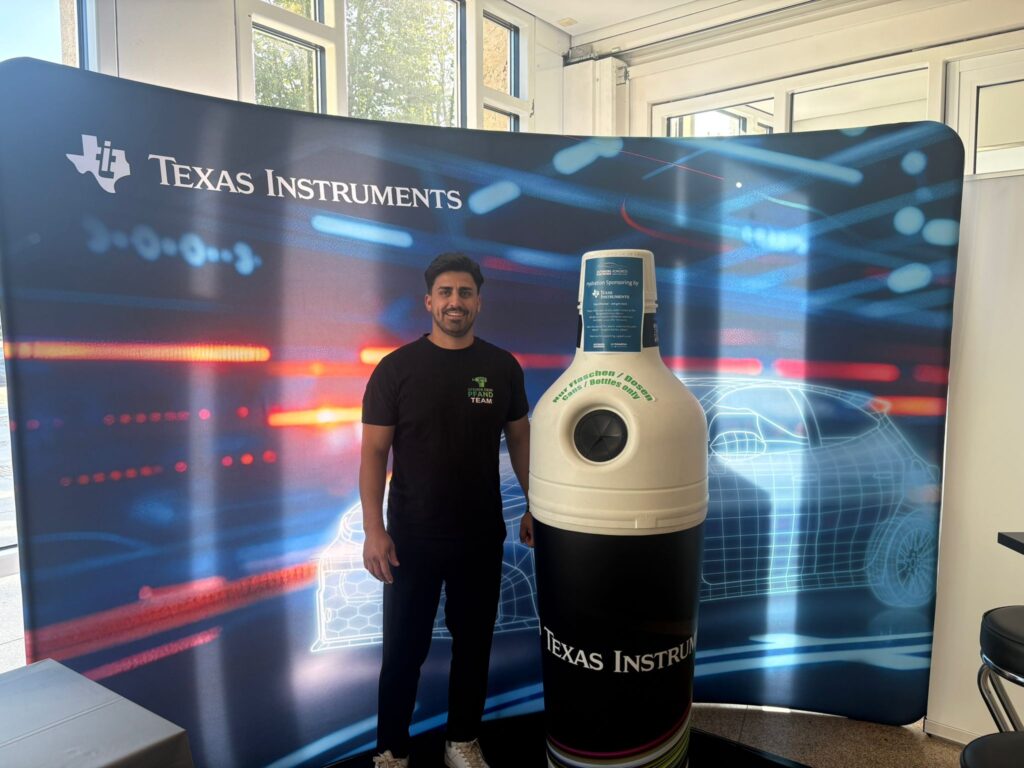
The bottle deposit container is modelled on an oversized bottle. This is not an end in itself: an object that looks like what belongs inside it needs no explanation. People understand it from ten metres away without reading a sign.
Five colours are available — white, black, blue, yellow and orange. The decision should depend less on taste than on the background: a white container in front of a white wall disappears, an orange one stands out in almost any setting. Where restraint is called for, say in a prestigious foyer, black or white is the calmer choice.
Locking system: when you need it
A locking system prevents anyone from taking the collected empties back out. It is needed wherever the container stands unattended at times:
- outdoors, including overnight
- on sports grounds and publicly accessible areas
- in buildings open to the public outside operating hours
In a closed office building or a staffed canteen, you can do without it. When in doubt: it costs little and cannot be improvised afterwards.
Do not forget the consumables
Deposit bags are the only ongoing material. They line the container, keep it clean and become the transport container when the empties are collected. Available in two sizes, matching the two container volumes, each in packs of one hundred.
How long a pack lasts depends on your volume. As a rough calculation: one bag per emptying. If you empty weekly, a pack of one hundred lasts almost two years.
Hygiene and care in everyday use
The most common concern before purchase — especially in canteens, schools and medical practices — is odour. It is justified, but easy to dispel if three things are right.
Only empty drinks containers, no food scraps. The container is not a rubbish bin. Clear labelling ensures this is understood — one more argument for the wrap.
Residual liquid is normal, but not a problem, as long as the container is emptied regularly. It only becomes problematic if a full container stands for weeks — over the summer holidays, say, or a company shutdown. An item on the checklist before longer closures is all it takes.
The deposit bags are the real protection. They catch anything that drips. When the bag is changed, the inside of the container is clean again — no wiping out required.
The can container additionally has a rubber rosette at the opening that keeps out insects and rain. In summer and outdoors, that is the point that decides how happy you will be.
The cleaning effort is therefore practically zero: change the bag, occasionally wipe the outside with a damp cloth, done.
What it adds up to
A realistic starter kit for one location consists of container, wrap and deposit bags — optionally the locking system. The current prices are in the Shop; they are openly displayed there, including VAT.
There is an important distinction when it comes to shipping: The containers are bulky goods and are delivered by freight carrier, which incurs a flat shipping fee. Wraps, locking systems and deposit bags ship free of charge. So if you are ordering a container anyway, it is best to add the accessories at the same time — in the same order, shipping is only charged once.
Delivery and returns
Allow around two weeks from order to delivery. With your own design, add the time needed to coordinate the draft.
As a consumer, you have a fourteen-day right of withdrawal; the details are set out in the Withdrawal Notice. With bulky goods, bear in mind that you bear the direct costs of the return — one more reason to settle the size beforehand rather than afterwards.
What comes after the purchase
The container is only the beginning. Things get interesting when it is full.
We collect the accumulated empties free of charge — across Germany and in Austria. You store them temporarily in the deposit bags, get in touch once a sensible quantity has accumulated, and we take care of the rest: collection, redeeming, settlement. How this works in detail is described under Have your deposit donations collected.
The proceeds go entirely to charitable projects. You have a say in which one is supported; the selection is listed under Donation Goals. That is the real difference from an ordinary collection container: the empties turn into not just tidiness, but support. How the model works as a whole is explained under Donate your deposit.
Where the purchase particularly pays off
Not every place needs a deposit container. Four constellations in which it reliably pays off:
Businesses with a drinks machine or canteen. Here, empties accumulate daily and predictably. The container replaces the jumble of crates behind the kitchen and makes the commitment visible to employees and visitors. What else companies gain from it is described under Deposit box for companies.
Schools and clubs. A steady volume, a natural sponsoring body and a donation goal that can be decided on together.
Sports facilities and clubhouses. At the side of the pitch and at home matches, quantities accumulate that would otherwise end up in residual waste. Because of the open access, a locking system is usually part of the package here.
Medical practices, law firms and reception areas. Less volume, but high visibility. What counts here above all is the impression created — a discreetly designed container in white or black says something about the attitude of the house.
Where hardly any drinks in single-use packaging are served, however, a container is the wrong tool. We will tell you that too when we talk.
Checklist before ordering
- Which empties accumulate at your site — bottles, cans, cups or mixed?
- How much per week, and how often can someone empty it?
- Where will the container stand — indoors or outdoors, staffed or unattended?
- Which colour stands out from the background?
- Wrap added to the order? Standard or your own design?
- Locking system needed?
- Deposit bags in the basket?
- Who is responsible for emptying at your site — and who stands in for that person?
Frequently asked questions
Are there any running costs?
No. The container is a one-off purchase, and collection is free of charge. The only consumable is deposit bags.
Can we design several containers differently?
Yes. The wrap is ordered per container, so you can label locations differently.
Will we receive a donation receipt?
Talk to us — what is possible depends on the circumstances and is clarified case by case.
How heavy is the container?
Empty, it can be moved by one person. Once full, it should no longer be pushed but emptied via the deposit bags.
Is the container suitable for outdoor use?
Yes, the material is weather-resistant. For unattended locations, we also recommend the locking system.
And what if we get the size wrong?
Talk to us beforehand. We will also tell you if one container is enough where you had planned for two.
In brief
A deposit container is not a complicated purchase, but there are four points where things go wrong if you skip them: a design that matches the empties, a realistic emptying rhythm instead of maximum volume, the wrap, which is not included automatically, and a named person who takes care of it.
Once these four are in place, the rest runs by itself.
Not sure what suits your location? Write to info@spendedeinpfand.com or arrange a free consultation via the contact page. For businesses, the options are bundled under Deposit box for companies.
From empties to support
Spende Dein Pfand provides deposit containers for companies, clubs, schools and events. We collect free of charge and pass on the proceeds in full to charitable projects.