Many businesses have that one spot: the corner next to the kitchen, the corridor behind the storeroom, the pile by the loading ramp. That is where empties, crates and loose bottles accumulate. At some point someone takes them to the reverse vending machine, usually as an extra errand, usually someone who actually has other things to do. The deposit then ends up in the coffee fund or disappears altogether.
This is exactly where the idea of donating deposits in the company comes in. It requires no change to your processes and no budget for running costs. It requires a container that stands in plain sight, and the willingness to pass on the result. This article describes what is behind it, what benefits a business gains from it, what the process looks like in practice and what implementation costs.
What “donating deposits” actually means in a company
In Germany, single-use drinks packaging carries a deposit of 25 cents, and reusable bottles 8 or 15 cents depending on the type. This money belongs to whoever returns the packaging. In a business, this is rarely clearly settled: the bottle belongs to the person who bought it, the trip to the reverse vending machine costs working time, and the individual amounts are too small to attract attention.
A deposit donation turns this ambiguity into a decision. Instead of storing the empties somewhere in the meantime, the business sets up a collection container into which guests, customers and employees drop their empties. Whoever drops something in consciously gives up their 25 cents. The collected proceeds then go to charitable projects.
The difference from a classic donation box is fundamental: nobody has to take money out of their pocket. The contribution has already been paid — it sits in your hand in the form of an empty bottle. This low threshold is the reason the containers work even where appeals for donations otherwise remain ineffective.
Why empties are an underestimated issue in the workplace
Anyone who works in hospitality, retail, manufacturing or a larger office knows the side effects: empties take up space that is actually needed for other things. They wander between kitchen, storeroom and backyard. They spark discussions about who takes on the trip to the reverse vending machine. And they create an image nobody in the business consciously chose — half-full crates next to the entrance, loose bottles on windowsills, overflowing waste-paper bins after events.
At events, the picture intensifies. At trade fairs and festivals, empties pile up at a speed no normal cleaning routine can absorb. Bottles and cans then stand on bar tables, under benches and next to waste bins where they do not belong — because there, not only the deposit is lost, but the material also drops out of the cycle.
A visible collection point solves both at once: the empties get a defined place, and the way there is more attractive than the waste bin because it has a recognisable purpose.
What companies gain from it
Commitment you can see
Many sustainability measures in a company are invisible. A green electricity contract, an optimised supply chain, a change in procurement — all of this matters, but nobody notices it when entering the building. A deposit container stands in the room, carries your own logo and explains itself. It is one of the few measures that guests and employees notice every day and can take part in directly.
Less effort, not more
The decisive point for everyday operations: the task disappears, it does not grow. The empties have a fixed place, the trip to the reverse vending machine is no longer needed, and neither is the settling up. What remains is a short message when the container is full.
Something your employees will talk about
Employee engagement rarely fails for lack of will, but rather at feasibility. Campaigns that cost extra appointments, registrations or free time reach a small circle. A collection campaign that works in passing reaches everyone. It also lends itself as a framework for more: teams can vote on which project to support, trainees can look after the campaign, and a notice can show what has come of it.
A verifiable contribution to your public image
Partner businesses receive the initiative's cooperation seal and may display it on their website, in their menu and on social media. The seal is not a purchased label — it documents an existing cooperation. For companies that want to document their commitment, this is a concrete, verifiable point — in contrast to general declarations of intent.
Three ways businesses can take part
Not every business needs the same solution. An office location with thirty people has different requirements from a festival site. That is why there are three models, which differ in effort and visibility.
| Model | Suitable for | What you do | What the initiative takes care of |
|---|---|---|---|
| Set up a container | Companies, hospitality, clubs, schools — anywhere with a regular volume of drinks | Set up the container, choose a location, let us know when it is full | Delivery, wrap, collection, redeeming, accounting, passing on the donation |
| Deposit Collection | Businesses that already collect and do not need an additional container | Provide the empties and arrange an appointment | Free collection, redeeming, accounting, passing on the donation |
| Event service | Trade fairs, festivals, congresses, city festivals, company parties | Specify the area and time period | Containers, on-site support staff for the entire duration, removal |
The three routes can be combined. A company with a fixed location and several trade fair appearances a year often uses its own container in-house and the event service for off-site dates. You will find a detailed comparison on the page Get involved.
The process step by step
1. Clarify your needs
It starts with a simple question: how many empties do you accumulate per month? From this follows how many containers make sense and which variant fits. For an initial estimate, all it takes is the Needs Calculator; if you are unsure, it can be settled in a short conversation.
2. Choose your container and design
The bottle deposit container is 1,800 millimetres tall with a diameter of 580 millimetres and holds 210 litres. The material is LLDPE, a robust plastic that can be used indoors and outdoors. There are separate variants for cans and for reusable cups — at events with reusable cups, the cup deposit container is the right choice.
For the design, two routes are open: the standard wrap in the initiative's design or a custom wrap in your own design. For the custom wrap, you send your logo and colours after ordering; the initiative takes care of the design.
3. Set up
The container is delivered and set up in a clearly visible, accessible spot. The location determines the success — more on this further below.
4. Let the collecting happen
From here on, nothing more happens at your end. Guests and employees drop in their empties. A notice at the opening explains where the proceeds go — this noticeably increases participation, because the purpose is visible at the moment of decision.
5. Collection and passing on
When the container is full, a short message is all it takes. Collection is free of charge and available throughout Germany and in Austria. Redeeming, accounting and passing on the donation are handled by the initiative. The proceeds from the collected deposits go entirely to the supported projects — the initiative funds itself through the sale of the containers, not through the collected deposits.
What implementation costs
There is exactly one cost item: the container and the design you choose. After that, there are no running fees, no contractual commitment and no costs for collection.
| Item | Price | Note |
|---|---|---|
| Bottle deposit containers | 449,50 € | 1,800 mm tall, 210 litres, LLDPE |
| Custom wrap, body | 139,63 € | large advertising space in your own design |
| Custom wrap, neck | 79,95 € | upper section |
| Notice wrap at the opening | 88,50 € | explains the purpose at the insertion opening |
| Locking system | 49,50 € | optional, for publicly accessible locations |
| Collection | free | throughout Germany and in Austria |
All prices include VAT plus shipping costs. You will find the standard wrap and all other variants in the Shop.
Why not 30 euros?
The question comes up regularly, and it is justified. For around 30 euros you can buy a collection bag or a household bucket online. Those are two different things. This is about a commercial collection unit: 1.80 metres tall, 210 litres, made of robust plastic, with an advertising surface wrapped in your own design — and with collection that permanently costs nothing afterwards. If you are just looking for a receptacle, you will do better at the DIY store. If you want a visible collection point for guests, you will find nothing comparable under 400 euros.
Where the container actually works in your business
The location determines success more than anything else. Three rules of thumb have proven their worth.
- Where people drink — not where waste is disposed of. A container in the basement corridor next to the rubbish bins will hardly be used. One next to the drinks machine, in the canteen, in the break room or at the exit becomes a natural stop along the way.
- Along the way, not off to the side. People do not make detours for 25 cents they are giving up anyway. The container should stand where people pass by anyway.
- Visible and explained. A wrapped container with a short notice at the opening answers the question “What is this?” without any staff. Without an explanation, it turns into a rubbish bin.
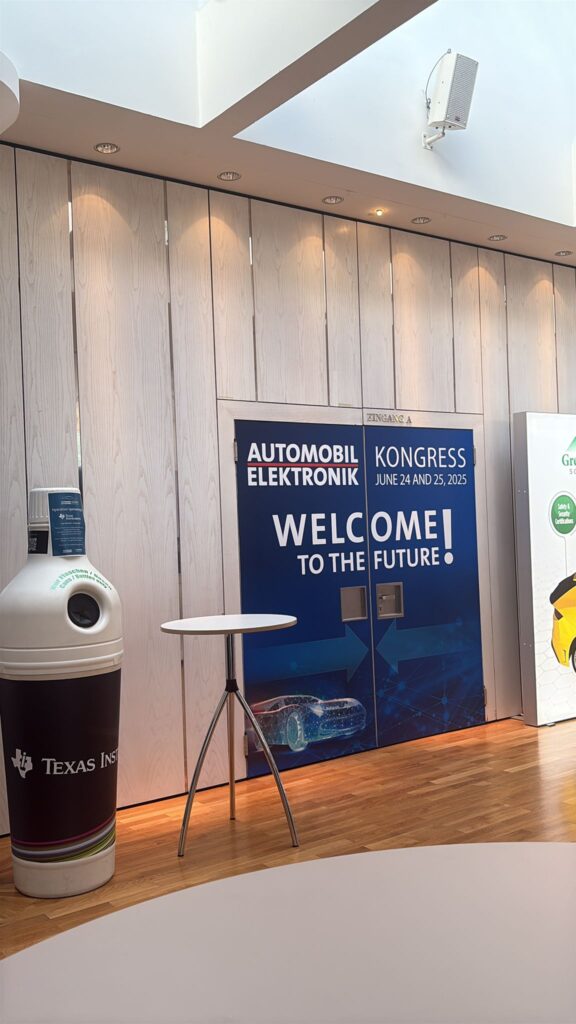
At events, a fourth point comes into play: volume and speed. At trade fairs and festivals, a container fills up faster than anyone can empty it on the side. That is why the event service includes support staff who are on site for the entire duration. It has been in action at Texas Instruments at the Automobil Elektronik Kongress in Ludwigsburg, at gamescom and at trade fairs run by Koelnmesse, among others.
Practical questions that come before the decision
Does it not get unhygienic?
What is collected is empty packaging, not food waste. In practice, this corresponds to what already sits in crates next to the kitchen anyway — just in a defined place and in a closed container instead of out in the open. The plastic can be wiped down with a damp cloth. Where high standards apply, for instance in hospitality or in care facilities, a location outside the preparation areas and a shorter collection interval are recommended.
How much space does the container need?
With a diameter of 580 millimetres, the footprint is roughly that of a larger waste-paper bin. Upwards, the container needs 1.80 metres — so it uses height instead of floor space. That is why it also works in corridors, foyers and next to drinks machines, where a collection crate would be in the way.
What about publicly accessible locations?
For locations where the container stands unattended — foyers, outdoor areas, event grounds — there is a locking system. It prevents unauthorised persons from removing the contents and is available as an accessory.
And what about tax?
A distinction is worth making here: whoever drops in empties gives up their own deposit — so as a rule, the company does not donate from its own funds, but provides the collection point. Whether and in what form a donation receipt may be an option depends on the specific arrangement. We clarify this together with you on a case-by-case basis; it does not replace tax advice.
What becomes of the empties
Two cycles run in parallel. The material one: single-use packaging carrying a deposit goes into recycling via the return system instead of ending up in general waste or in the landscape. The financial one: the deposit that would otherwise lapse or trickle away into the coffee fund is pooled and goes to charitable projects.
For businesses that do not want the circular economy to be just a term in their sustainability report, this is a tangible starting point: a measure that takes place in-house, whose impact employees see every day and which can be implemented without changing external processes.
How to make the campaign known in your business
A container nobody explains turns into a rubbish bin. A container whose purpose is known fills up. What has proven effective:
- Mention it once, do not promote it permanently. A brief mention in the team meeting or on the intranet is enough if the container itself is visibly explained.
- Name the goal. “For the Kölner Tafel” has a different effect from “for a good cause”. The notice at the opening can do exactly that.
- One person who feels responsible. In practice, the campaign works best where someone — often a trainee or someone from reception — keeps an eye on it and lets us know when a collection is due.
- Report back on what came of it. A notice or a short intranet post about the supported project closes the loop and keeps participation high.
- Involve your guests. In hospitality, gyms and reception areas, the container is also a conversation starter — and a visible sign of what the business stands for.
Where the deposit goes
The donation goals are not assigned according to the state of the coffers, but selected by a team that knows and has vetted the projects. Currently supported are, among others, the food banks in Cologne and Düsseldorf, the Omid Online School for girls in Afghanistan, Women for Justice in Shingal, the mentoring programme of Legmon e.V. and Naturschutz2go, where disused chewing gum machines become seed dispensers.
Partner businesses can have a say in the donation goal. You will find an overview of all projects under Donation Goals.
Frequently asked questions
How much work remains with us in the business?
Set up the container and let us know when it is full. Redeeming the deposit, the accounting and passing on the donation are handled by the initiative.
What does pickup cost?
Nothing. Collection of the gathered deposit is free of charge. The only one-off costs are for the container and, if desired, the wrap.
Do you also collect at our location?
The initiative is active throughout Germany and in Austria. State your location when ordering — collection for your region will then be arranged.
How often is it collected?
As needed. There is no fixed schedule you have to follow. You get in touch when the container is full; for events, the rhythm is agreed in advance.
Is the container also available for cans or cups?
Yes. The bottle deposit container is intended for PET bottles, not for glass. There are separate variants for cans and for reusable cups.
Does the container arrive with our logo on it?
The wrap is a separate item and not included as standard. You can start with the standard wrap or order a custom wrap in your own design — you send your logo and colours after ordering.
Are we tied into a contract?
No. You buy the container; after that, there are no ongoing obligations. If you want to end the campaign, the container remains your property.
Can we choose the donation goal ourselves?
Partner businesses can have a say in which of the supported projects receives the collected deposit. It is best to agree on this before setting up.
Do we get something we can show?
Yes — the cooperation seal for your own communications, plus material in the download area for partners. Everything else on this can be found on the page Partnerships.
Is it worth it for your business?
The honest answer hangs on one question: do you regularly accumulate empties, and do people pass by them? If yes, a deposit donation is one of the few measures that at the same time reduces effort, becomes visible and makes a verifiable contribution — with one-off costs and no ongoing commitment.
If not — for instance in a pure office location with few people and a water dispenser — the route via the free collection of already gathered deposits makes more sense than a container of your own.
For everything in between: a brief assessment costs nothing. Write to info@spendedeinpfand.com, call us on 0221 29246389 or use the contact page to arrange a no-obligation consultation. We usually get back to you within one working day.
From empties to support
Spende Dein Pfand provides deposit containers for companies, clubs, schools and events. We collect free of charge and pass on the proceeds in full to charitable projects.